



Nat’l Tymes News Desk

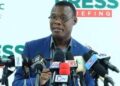
THE DEPUTY Director-General of Ghana’s Securities and Exchange Commission (SEC), Mensah Thompson, has called for urgent reforms and investment to strengthen the country’s capital market, describing it as a critical pillar for sustainable economic growth.
Posted on his Facebook wall after a working visit to Washington D.C., Mr. Thompson highlighted the stark contrast between Ghana’s financial system and that of the United States.
According to him, while banks dominate Ghana’s economy, the U.S. economy is largely driven by its capital market, which mobilizes funds for infrastructure, private sector growth, social welfare, and even national defense.
“In the United States, the capital market is the backbone of the economy. It drives development and supports long-term growth. In Ghana, however, banks play that dominant role, and that is an imbalance we must urgently correct,” he said.
Mr. Thompson stressed that a strong capital market has the potential to mobilize far more resources than the banking sector. “The capital market can generate up to 100 times the total deposits of banks annually, yet in Ghana, we are not even reaching 10 percent of banking sector assets. This gap is slowing down our economic progress,” he explained.
He also raised concerns about the challenges facing the SEC, describing the Commission as one of the most underfunded institutions in the country. He revealed that the SEC currently operates with only 85 staff members, far below its optimal capacity of 200, due to financial and infrastructure constraints.
Despite these limitations, the SEC is responsible for regulating a wide range of activities in Ghana’s financial sector. These include overseeing the stock exchange and its members, approving IPOs, bonds, and commercial paper issuances, regulating fund managers, supervising public listed companies, and even licensing crypto platforms and market professionals such as auditors and lawyers.
“The workload is enormous, yet we remain understaffed, under-resourced, and among the least paid in the financial sector. Still, we have some of the best minds working tirelessly for Ghana,” Mr. Thompson argued.
He pointed out that despite these challenges, Ghana’s capital market recorded nearly 10 percent growth last year—the strongest performance since the Domestic Debt Exchange Programme (DDEP). He believes this signals significant untapped potential.

Mr. Thompson explained that the SEC’s visit to the United States is aimed at learning global best practices to transform Ghana’s capital market. Key areas of focus include municipal bond issuance, which could empower local governments to fund infrastructure independently, and regulatory strategies to boost capital formation.
“Our goal is clear—to build a robust capital market that provides unlimited capital for businesses, infrastructure, and industrial growth. This will help create jobs, reduce import dependence, and stabilize our currency,” he said.
He emphasized, however, that achieving this vision depends on strengthening the SEC itself. “We must first build the SEC into a world-class regulator. Without that foundation, the transformation we seek will remain out of reach,” he concluded.
Source: Nationaltymes.com