



THE same government official who signed the financial clearance to recruit over 15,000 nurses and midwives is now sitting on a committee tasked with investigating the very system that has long frustrated health workers.

Critics say it’s the typical Ghanaian irony — those who help create the mess are the same ones called to fix it.
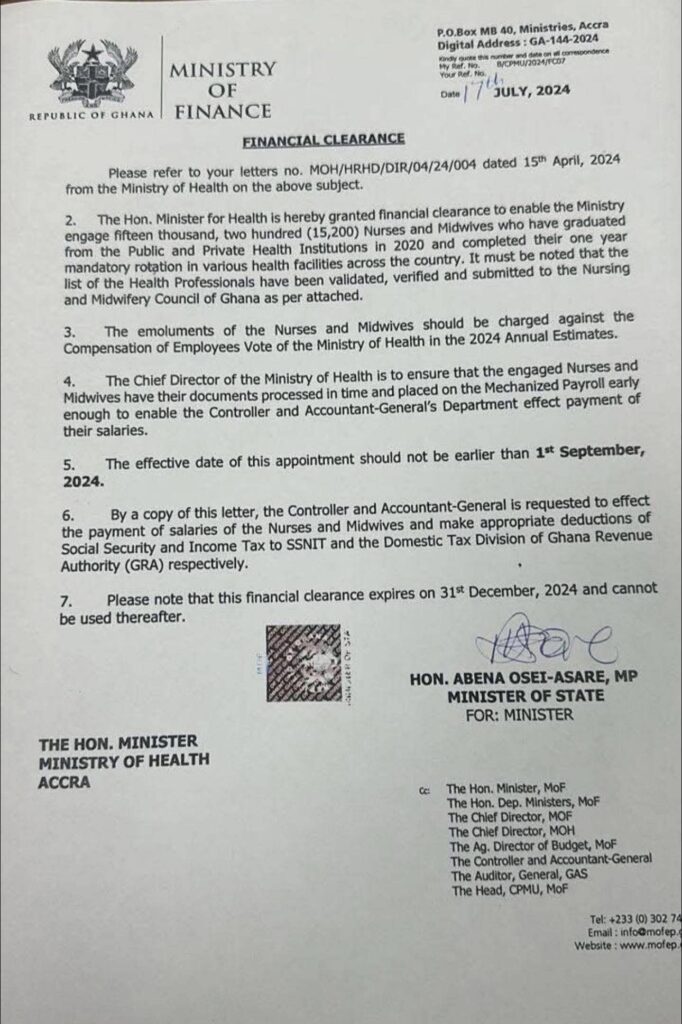
These are health professionals who completed their training in 2020 and have since finished their one-year mandatory national service.
A letter dated 17th July 2024 and signed by Hon. Abena Osei-Asare, Minister of State at the Ministry of Finance, confirms this approval. The letter allows the Ministry of Health to formally employ the qualified nurses and midwives into the public health sector.
Per the directive, only those whose names have been validated by the Nursing and Midwifery Council of Ghana will benefit. Their appointments will officially begin from 1st September 2024, and salaries will be charged against the Ministry of Health’s compensation budget for the year.
The clearance expires on 31st December 2024. All personnel must be added to the Mechanized Payroll early to avoid payment delays, and statutory deductions like SSNIT and GRA contributions will apply.
This move aims to reduce youth unemployment and strengthen healthcare delivery in Ghana, especially in rural communities. However, many nurses remain concerned about delays in postings and payroll issues that often follow such announcements.
Public Concern Over Irony
Interestingly, the same minister who signed off the financial clearance, Hon. Abena Osei-Asare—is now serving on a parliamentary committee set up to investigate issues in Ghana’s health and payroll systems.

Critics have pointed out the irony, asking how those who play key roles in creating systemic challenges are also asked to investigate or fix them. As one observer put it: “After issuing this clearance, she now sits, without shame, on a committee tasked with probing those alleged to have messed up the system. The irony? In Ghana, those who contribute to the mess are often the same people called upon to fix it. The cycle continues, unchecked.”
The development has sparked renewed calls for more transparency and accountability in public sector recruitment and governance.
Source: Nationaltymes.com